
Wild Sauna & Cold Water Therapy: What the Science Actually Says (UK Guide, 2026)
Quick answer
Regular sauna bathing (4–7 sessions a week) is linked to a 63% lower risk of sudden cardiac death and a 50% lower risk of fatal cardiovascular disease compared with once-a-week use, according to a 20-year Finnish cohort study. Cold water immersion, meanwhile, has been shown in a 2025 meta-analysis of 3,177 participants to measurably improve mood and reduce stress. Combined — heat, then cold — this is the basis of the wild sauna ritual now spreading across the UK, where the number of public saunas more than doubled between 2023 and 2024.
This guide breaks down what the actual research says, how wood-fired saunas compare to electric ones, how often you need to go to see benefits, and what to watch out for.
What is a wild sauna?
A wild sauna is a traditional, usually wood-fired sauna set up outdoors — beside a lake, river, or the sea, or simply in a field or garden — rather than inside a spa or gym. The "wild" part refers to the setting and the ritual built around it: heat in the sauna, then a cold plunge or dip outdoors, repeated in cycles. It's the Nordic model of sauna bathing, and it's the format Zen Den Wellbeing runs across Lancashire and West Yorkshire.
Unlike an electric sauna cabin bolted into a leisure centre, a wild sauna is usually mobile (built into a trailer, tent, or barrel), heated by a wood-burning stove, and designed to be used alongside cold water — a lake, a dip tank, or open water.
What are the health benefits of sauna bathing?
Direct answer: The strongest evidence is cardiovascular. A landmark 20-year study of over 2,300 Finnish men (Laukkanen et al., published in JAMA Internal Medicine, 2015) found that men who used a sauna 4–7 times a week had a 63% lower risk of sudden cardiac death and a 50% lower risk of fatal cardiovascular disease, compared with men who went once a week. The relationship was dose-dependent — the more frequent the sessions, the lower the risk, with no threshold effect.
A follow-up cohort study published in BMC Medicine (2018) confirmed the pattern in both men and women, and found that adding sauna habits to standard cardiovascular risk calculators improved how accurately long-term risk could be predicted. More recent analysis (2024) also found frequent sauna bathing appears to counteract some of the negative effects of high blood pressure on mortality risk.
The proposed mechanisms, per the Mayo Clinic Proceedings review of the evidence, include:
Improved autonomic nervous system regulation (higher vagal tone, lower sympathetic activity)
Reduced inflammatory markers, including C-reactive protein
Short-term increases in heart rate similar to moderate-intensity exercise
This doesn't mean a sauna replaces exercise or medical care — the studies are observational, tracking habits over decades, not controlled drug-style trials. But the association is consistent and well-replicated, which is why sauna bathing is increasingly discussed as a legitimate cardiovascular health habit, not just a spa indulgence.
Wood-fired sauna vs electric sauna: what's the difference?
Direct answer: Both raise core body temperature and trigger the same physiological responses studied in the research above. The differences are in heat quality, ritual, and setting — not in whether the health benefit "counts."
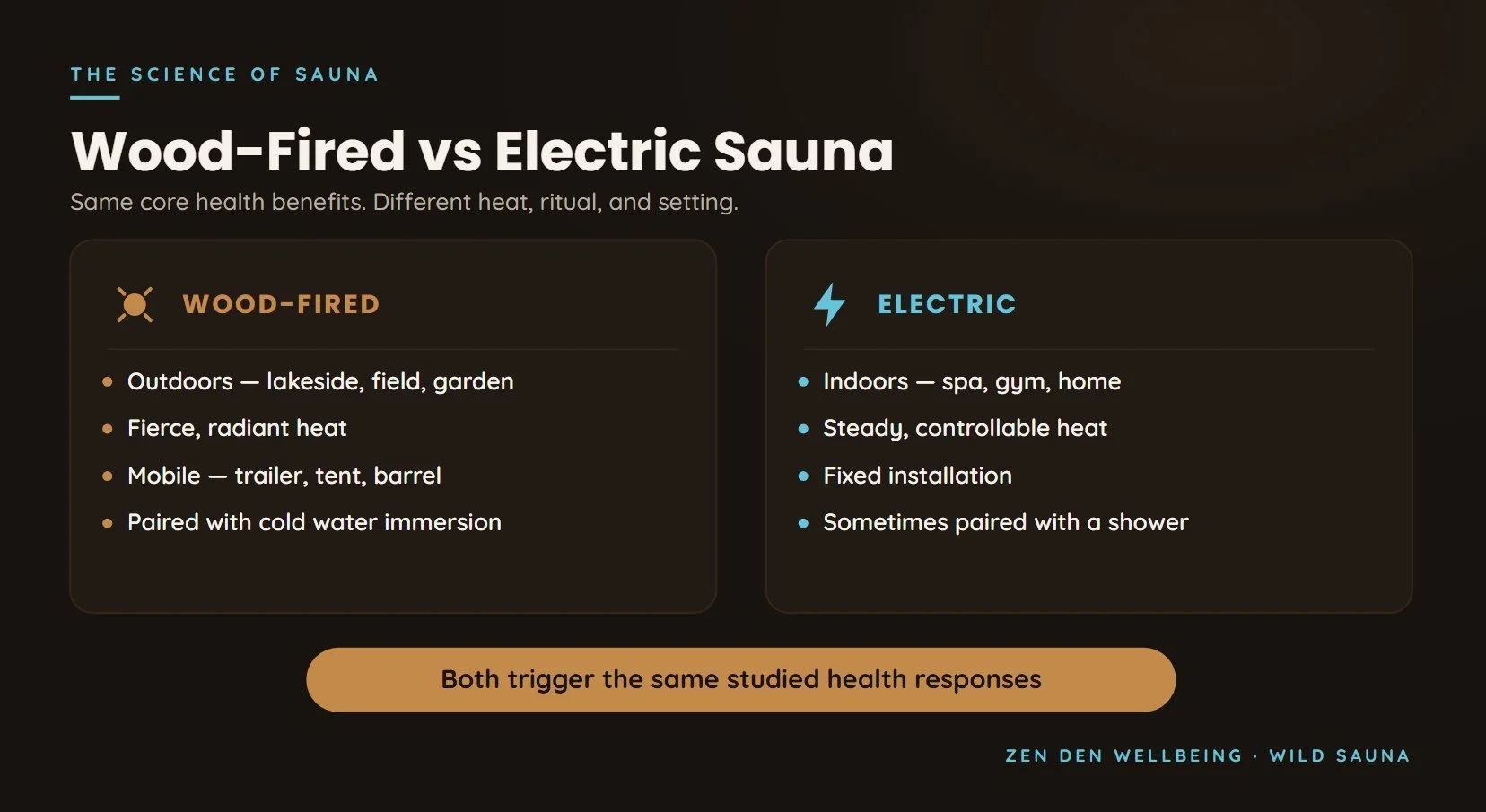
Neither is "better" in a clinical sense - the studies above measured sauna bathing generally, not one heat source specifically. The choice usually comes down to ritual and experience: wood-fired wild saunas lean into the outdoor, social, nature-connected side of the practice, which is a large part of why they've taken off in the UK.
What are the benefits of cold water immersion after a sauna?
Direct answer: A 2025 systematic review and meta-analysis of 11 randomised controlled trials (3,177 participants) found cold water immersion was associated with measurable improvements in mood, reductions in stress, and enhanced mental wellbeing.
A separate 2025 controlled trial found cold immersion produced greater improvements in self-reported energy, mental clarity, and stress tolerance compared with a meditation-only control group. The proposed mechanism is activation of the sympathetic nervous system, which triggers release of noradrenaline, dopamine, and cortisol — the same "alert but calm" hormonal shift associated with the post-cold-plunge feeling many people describe.
Researchers are clear that the evidence base, while growing quickly, is still younger and less extensive than the sauna-cardiovascular research; timing matters (some studies found stress reduction was more pronounced 12 hours after immersion, not immediately), and most trials are still short-term. It's a promising, physiologically plausible practice rather than a fully proven medical intervention, which is a fair way to describe where the science currently stands.
Combining the two — heat, then cold, in cycles — is the traditional Nordic contrast therapy model, and it's the structure of a typical wild sauna session.
How often should you use a sauna to see benefits?
Direct answer: The Finnish cohort data associates 4–7 sessions a week with the largest cardiovascular benefit, but the relationship is linear — meaning even 2–3 sessions a week showed meaningfully lower risk than once a week, with no minimum threshold required to see some benefit.
For most people using a wild sauna occasionally rather than daily, the honest takeaway is: more regular, moderate use appears to beat occasional, infrequent use. A weekly or fortnightly wild sauna session, done consistently over months and years, fits the pattern the research actually measured — this was 20 years of habit tracking, not a one-off intense
Is wild sauna safe? What to know before you go
Sauna bathing is safe for most healthy adults, but a few groups should check with a GP first: anyone with unstable cardiovascular disease, pregnant women, and anyone who feels unwell in heat generally. Cold water immersion carries its own specific risk — cold water shock — which is why sessions should always be supervised, gradual, and time-limited rather than a sudden long plunge.
Sensible basics for any wild sauna and cold water session:
Stay hydrated before and after
Avoid alcohol before sauna or cold water immersion
Keep cold immersion short (seconds to low minutes), not prolonged
Never immerse alone in open water
Exit the sauna if you feel dizzy, nauseous, or unwell
Why wild sauna is booming in the UK right now
This isn't a niche trend anymore. The British Sauna Society recorded the number of public saunas in the UK more than doubling between 2023 and 2024 — from around 45 to over 100 — with growth continuing into 2025. Industry analysis puts the UK Saunas & Solariums market at roughly £589.8 million in 2026, spread across nearly 3,900 businesses, having grown at a compound annual rate of around 10% between 2020 and 2025.
Much of that growth is tied to wild swimming's own rise in popularity — sauna and cold water have become a natural pairing, and outdoor saunas are increasingly described as rivalling the pub as a place to meet, unwind, and socialise without alcohol.
FAQ
Do you need to be fit to use a wild sauna? No. The research covers general adult populations, not athletes. Most healthy adults can use a sauna safely; anyone with a heart condition, high blood pressure, or who is pregnant should check with a GP first.
Is a wood-fired sauna hotter than an electric sauna? Not necessarily hotter by thermometer, but the heat is often described as more intense and radiant, since it comes from an open stove rather than a sealed element.
How cold does the water need to be for cold water immersion to work? Studies vary, but most cold water immersion research uses water around 10–15°C or colder — natural UK lake, river, and sea temperatures for much of the year already fall in or below this range.
Can I do a wild sauna session if I'm anxious about cold water? Yes — the cold water element is optional and can be built up gradually (a quick dip rather than full immersion, or skipping it altogether). The sauna heat benefits stand largely on their own in the research.
How long should a sauna session last? Most studied protocols use rounds of roughly 15–20 minutes in the heat, though this varies by individual heat tolerance — listen to your body over following a strict clock.
Ready to feel it for yourself?
Reading about a 63% lower risk of sudden cardiac death is one thing. Sitting in fierce, wood-fired heat beside a Yorkshire beck, then dropping into cold water with people who get why you're doing it — that's another.
Book a wild sauna session → Small groups, real wood-fired heat, cold water access included, from £15.
Not ready to book yet? Download the free Into the Heat sauna guide → and start at your own pace.
Planning something bigger — a hen do, retreat, or garden gathering? Explore private sauna hire →
Sources
Laukkanen, J. A., et al. "Association Between Sauna Bathing and Fatal Cardiovascular and All-Cause Mortality Events." JAMA Internal Medicine, 2015. pubmed.ncbi.nlm.nih.gov/25705824
Kunutsor, S. K., et al. "Sauna bathing is associated with reduced cardiovascular mortality and improves risk prediction in men and women." BMC Medicine, 2018. pubmed.ncbi.nlm.nih.gov/30486813
"Cardiovascular and Other Health Benefits of Sauna Bathing: A Review of the Evidence." Mayo Clinic Proceedings. mayoclinicproceedings.org
Systematic review and meta-analysis of cold-water immersion and wellbeing, PLOS ONE / PMC, 2025. pmc.ncbi.nlm.nih.gov/articles/PMC11778651
Forsten et al. "Effects of Regular Cold-Water Sea Swimming on Daily Indices of Mental Health." Lifestyle Medicine, 2025. onlinelibrary.wiley.com
British Sauna Society public sauna count, cited via Global Wellness Summit/industry press, 2025.
IBISWorld. "Saunas & Solariums in the UK Industry Analysis," 2025–2026. ibisworld.com